

Contents
Scroll to:
Scroll to:
On January 26, 2026, Professor Alexander Markovich Glezer, a leading scientist and leader of a scientific school in the field of studying and developing next-generation multifunctional materials, would have turned 80. Under his leadership, a number of fundamental and applied studies of nanocrystalline and amorphous functional materials were conducted. He is a leading Russian scientist in the field of materials obtained by melt quenching and severe plastic deformation. Alexander Markovich is known as a leading scientist in the application of electron microscopy methods to the study of condensed matter structure.
IN MEMORY OF ALEXANDER MARKOVICH GLEZER. Bulletin of the Siberian State Industrial University. 2026;(1):122. (In Russ.)
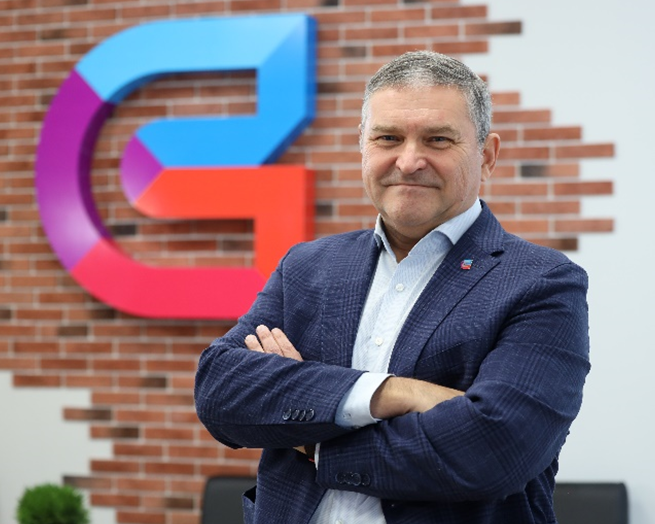
On January 26, 2026, Professor Alexander Markovich Glezer, a leading scientist and leader in the field of studying and developing next-generation multifunctional materials, would have turned 80. He supervised a number of fundamental and applied studies of nanocrystalline and amorphous functional materials. He is a leading Russian scientist in the field of materials obtained by melt quenching and severe plastic deformation. Alexander Markovich is known as a leading scientist in the application of electron microscopy methods to the study of condensed matter structure.
A.M. Glezer was the first to discover unusual effects of structural phase transformations associated with a high degree of supersaturation of materials with excess vacancies formed during melt quenching. He was also the first to establish and thoroughly analyze the size effect during martensitic transformation in nanocrystals. Alexander Markovich developed a new, original approach that allowed us to understand the nature of structural and phase transformations occurring during severe plastic deformation.
A.M. Glezer established methods and specific regimes for dramatically enhancing the magnetic, strength, and plastic properties of model and industrial functional materials based on iron, nickel, and cobalt. These methods are based on methods for producing nanocrystalline structures using melt quenching combined with severe plastic deformation. For over 20 years, he directed the G.V. Kurdyumov Institute of Metallurgy and Physics of Metals, one of Russia's most respected institutes in the field of materials science. Alexander Markovich Glezer is a laureate of the P.P. Anosov Prize of the Russian Academy of Sciences (2011) for outstanding scientific work in the fields of metallurgy, metallurgy, and heat treatment of metals and alloys. Alexander Markovich was the editor-in-chief of the journal "Deformation and Fracture of Materials," which is included in the Higher Attestation Commission (HAC) list and translated into English by Springer. He was also deputy editor-in-chief of the journal "Materials Science," and a member of the editorial boards of the journals "Izvestiya RAS. Physical Series," "Journal of Material Science & Technology," "Nanostructured Materials Science," "Fundamental Problems of Modern Materials Science," and "Problems of Ferrous Metallurgy and Materials Science."
A.M. Glezer served on the RAS Scientific Councils for Condensed Matter Physics, Nanomaterials, Metallurgy, and Metallurgy. He also served as one of the leaders of the Interstate Coordination Council for the Physics of Strength and Plasticity of Materials.
Alexander Markovich will be remembered as a brilliant and original scientist, a tireless researcher, a man of high moral principles and statesmanlike thinking. His name is forever inscribed in the history of metallophysical science. We will forever preserve the bright memory of this talented Man and Scientist!
IN MEMORY OF ALEXANDER MARKOVICH GLEZER. Bulletin of the Siberian State Industrial University. 2026;(1):122. (In Russ.)
 Email this article (Login required)
Email the author (Login required)
Email this article (Login required)
Email the author (Login required) Journal "Bulletin of the Siberian State Industrial University"
Registration Certificate: PI No. FS77-77872 dated 03.03.2020
The journal has an international standard serial publication number ISSN 2304-4497 (Print) and a subscription index in the Ural-Press catalog - 41270
Founder:
Editorial address:
654007, Kemerovo region - Kuzbass, Novokuznetsk, Central district, Kirov street, bldg. 42, Siberian State Industrial University, office 483гт, тел. 8(3843)-74-86-28
Responsible for the issues: Zapolskaya E.M.
Publisher: Federal State Budgetary Educational Institution of Higher Education “Siberian State Industrial University”, Novokuznetsk, Russia
Exclusive copyrights to the articles belong to the authors ©
Processing of personal data


